
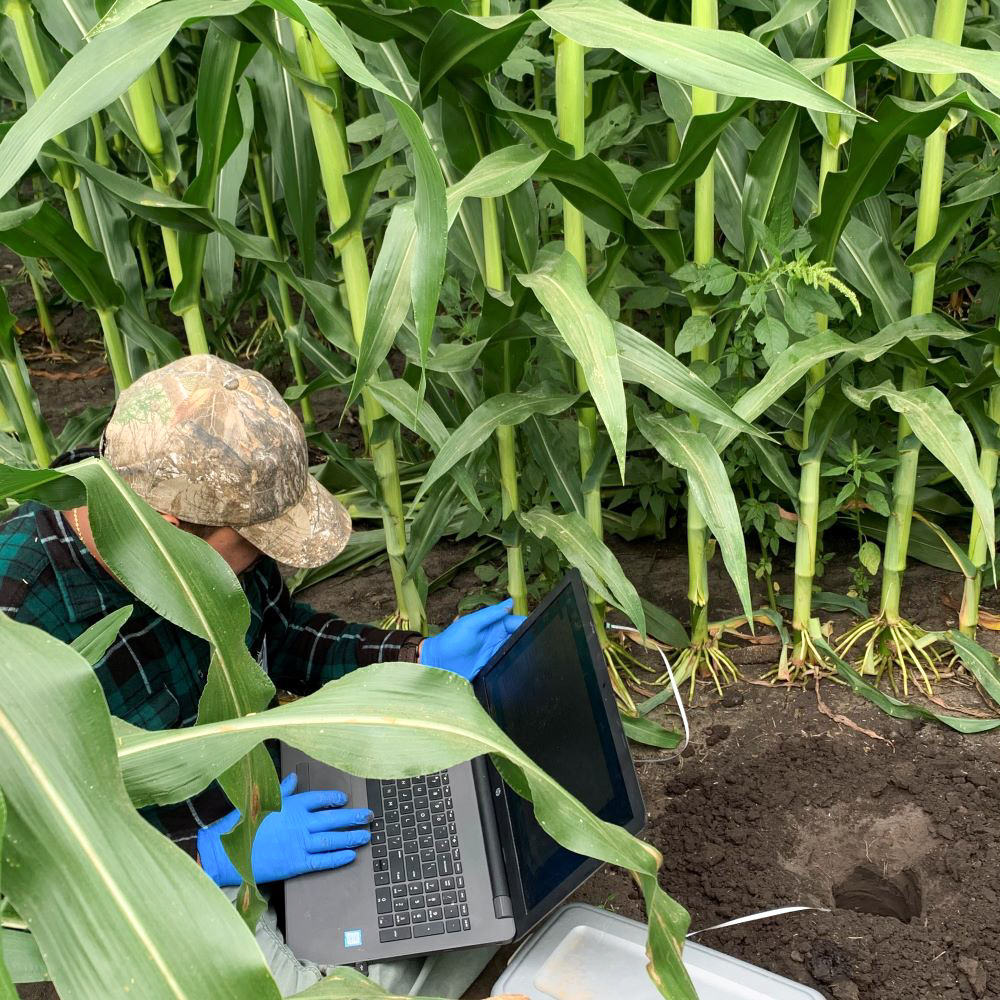
Vignesh Kumar Thoomatti Haridass, a postdoctoral research associate working with Iowa State’s Liang Dong, installs soil and stalk nitrate sensors within a cornfield. Larger photo. Photo by Liang Dong.
AMES, Iowa – Midwest researchers want to take some of the greenhouse gas emissions out of crop fertilizer.
Research teams from Iowa State University and Wichita State University in Kansas are teaming up to develop a system that captures waste nitrogen and carbon dioxide to produce a green fertilizer that reduces emissions of nitrous oxide, a greenhouse gas 300 times more potent than carbon dioxide.
The system’s big goal, according to a research summary, “is to promote N2O (nitrous oxide)- and CO2 (carbon dioxide)-relieved nitrogen fertilizers with economic resilience and environmental consciousness as an innovative way to mitigate the challenges posed upon climate change-threatened Midwest farming and ranching communities.”
The National Science Foundation is supporting the project with a four-year, $4 million grant, with half going to Iowa State and half going to Wichita State. The funding is from the agency’s Established Program to Stimulate Competitive Research (known as EPSCoR).
EPSCoR grants are designed to build scientific infrastructure and capabilities across the country. This grant is from EPSCoR’s “Track 2” program that promotes research collaborations among states or territories. The program’s current focus is “advancing climate change research and resilience capacity.”
One project, two teams
Wenzhen Li, a professor of chemical and biological engineering and the Herbert L. Stiles Faculty Fellow, will lead Iowa State’s work on the project. Other team members include Michael Castellano, the William T. Frankenberger Professor in Soil Science; Liang Dong, the Vikram L. Dalal Professor of Electrical and Computer Engineering; and Fallys Masambuka-Kanchewa, an assistant professor of agricultural education and studies.
The team’s tasks will include designing materials, processes and reactors for the electrochemical capture and conversion of waste nitrogen and carbon dioxide for a fertilizer known as “green urea,” modeling the nitrogen cycle in crops, developing and testing nitrogen sensors for crops and educating farmers and ranchers about the new fertilizer.
(Urea is a common ingredient in fertilizers and chemicals. Mammals use it to excrete nitrogen in urine; it must be purified before it can be used in fertilizer. High-purity urea can also be synthesized from inorganic materials.)
The researchers also want to boost the project’s sustainability by using wind and solar energy to power the electrochemical synthesis of their green fertilizer. “We want to take advantage of abundant renewable energy that Iowa and Kansas currently generate and use,” Li said.
Shuang Gu, an associate professor of mechanical engineering at Wichita State, will lead the project in Kansas. He’ll work with Mark Schneegurt, a professor of biological sciences; Janet Twomey, the College of Engineering’s associate dean for graduate studies, research and faculty success and a professor of industrial, systems and manufacturing engineering; and Ruowen Shen, an assistant professor in the Hugo Wall School of Public Affairs.
The Kansas team’s tasks will include capturing and concentrating nitrate, separating urea, studying soil microbial communities, conducting life-cycle assessments of green fertilizers and determining societal impacts of green fertilizers.
The Iowa State and Wichita State researchers have worked together on other projects, so it made sense to pursue this new collaboration.
“There is a seamless synergy between ISU in Iowa and WSU in Kansas in terms of shared common problems, united interest in Midwest farming and ranching, and complementing research expertise and education strength,” Gu said.
Building a whole new system
Li said the project will do more than create a new, green fertilizer product. It will create an entire system of technologies and understandings that could cut nitrous oxide emissions from fertilizer.
The researchers will figure out how to capture waste nitrogen and carbon dioxide from agricultural runoff. They’ll also develop technology to synthesize green urea from the collected nitrogen and carbon dioxide.
The researchers will also do life-cycle and economic analyses of using green fertilizer, develop advanced sensors for in-field measurement of nitrogen use by plants, study plant metabolism of nitrous oxide, look at the impacts of policy changes and work to encourage the use of green fertilizers.
“Living in the Midwest – the heart of agriculture,” wrote Gu and Li, “we felt obliged to do something to alleviate this national problem of greenhouse gas, nitrous oxide emission. The nitrous oxide-relieved nitrogen fertilizer could strengthen the long-term thriving and prosperity of Midwest agriculture, while mitigating climate-change issues.”